
【C++练级之路】【Lv.3】类和对象(中)(没掌握类的6个默认成员函数,那你根本就没学过C++!)
温馨提示:这篇文章已超过400天没有更新,请注意相关的内容是否还可用!
目录
- 引言
- 一、类的6个默认成员函数
- 二、构造函数(constructor)
- 2.1 引入
- 2.2 概念
- 2.3 特性
- 三、析构函数(destructor)
- 3.1 概念
- 3.2 特性
- 四、拷贝构造函数(copy constructor)
- 4.1 概念
- 4.2 特性
- 五、构造、析构、拷贝构造函数总结对比
- 5.1 构造函数
- 5.2 析构函数
- 5.3 拷贝构造函数
- 六、赋值运算符重载
- 6.1 运算符重载
- 6.2 赋值运算符重载
- 七、日期类的实现
- date.h
- date.cpp
- 八、const成员函数
- 8.1 概念
- 8.2 使用方式
- 8.3 日期类(const修饰版)
- 九、取地址及const取地址操作符重载
- 总结
欢迎各位小伙伴关注我的专栏,和我一起系统学习C++,共同探讨和进步哦!
学习专栏:
《进击的C++》引言
在C++的学习中,类和对象章节的学习尤为重要,犹如坚固的地基,基础不牢,地动山摇;而默认成员函数的学习,在类和对象的学习里最为重要。所以要学好C++,学好默认成员函数是一道必经之路,这样后续才能很好的学习后续模板,继承,多态等知识。
一、类的6个默认成员函数
如果一个类中什么成员都没有,简称为空类。
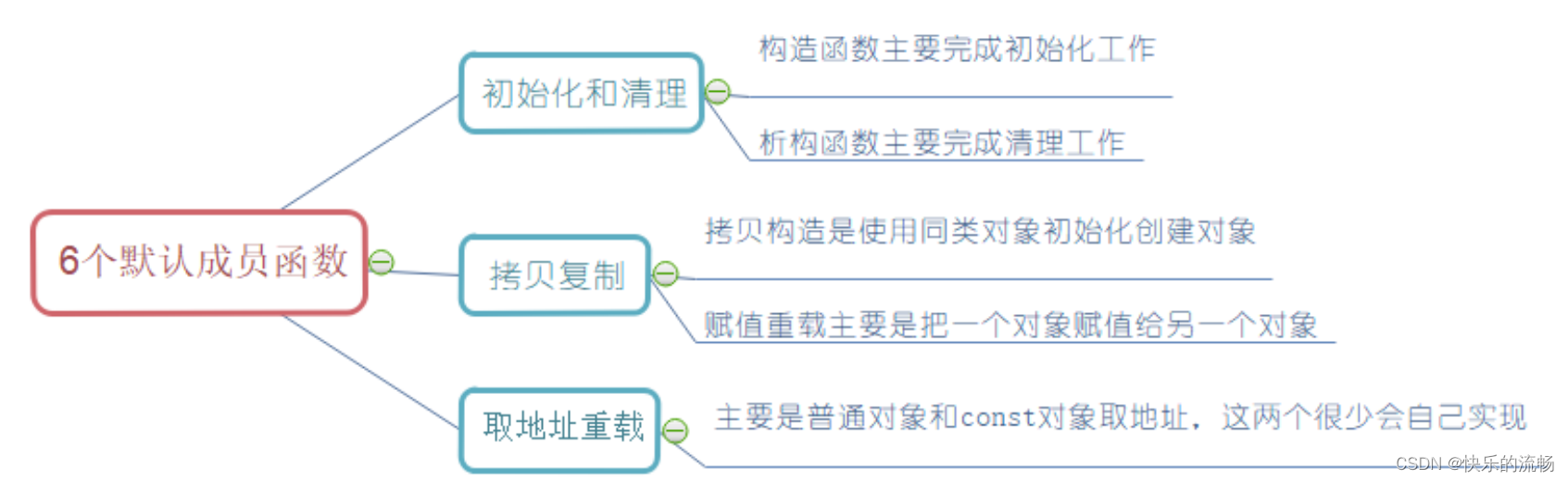
空类中真的什么都没有吗?并不是,任何类在什么都不写时,编译器会自动生成以下6个默认成员函数。
默认成员函数:用户没有显式实现,编译器会生成的成员函数称为默认成员函数。
二、构造函数(constructor)
2.1 引入
先来简易实现一个日期类Date
class Date
{
public:
	void Init(int year, int month, int day)
	{
		_year = year;
		_month = month;
		_day = day;
	}
	void Print()
	{
		cout
	Date d1;
	d1.Init(2023, 12, 5);
	d1.Print();
	return 0;
}

public:
	// 1.无参构造函数
	Date()
	{
		_year = 1;
		_month = 1;
		_day = 1;
	}
	// 2.带参构造函数
	Date(int year, int month, int day)
	{
		_year = year;
		_month = month;
		_day = day;
	}
	void Print()
	{
		cout
	Date d1;//调用无参构造函数
	d1.Print();
	Date d2(2023, 12, 5);//调用带参构造函数
	d2.Print();
	//warning
	Date d3();//函数声明
	return 0;
}

public:
	Date(int year = 1, int month = 1, int day = 1)//使用缺省参数
	{
		_year = year;
		_month = month;
		_day = day;
	}
	void Print()
	{
		cout
	Date d1;
	d1.Print();
	Date d2(2023, 12, 5);
	d2.Print();
	return 0;
}

public:
	void Print()
	{
		cout
	Date d1;//调用默认构造函数
	d1.Print();
	return 0;
}

public:
	Date()
	{
		_year = 1;
		_month = 1;
		_day = 1;
	}
	Date(int year = 1, int month = 1, int day = 1)
	{
		_year = year;
		_month = month;
		_day = day;
	}
	void Print()
	{
		cout
	Date d1;//报错,对重载函数的调用不明确
	d1.Print();
	return 0;
}

public:
	Stack(int capacity = 4)//构造函数
	{
		_a = (int*)malloc(sizeof(int) * capacity);
		if (_a == nullptr)
		{
			perror("malloc fail");
			return;
		}
		_top = 0;
		_capacity = capacity;
	}
	void Push(int x)
	{
		//CheckCapacity();
		_a[_top++] = x;
	}
	//...
	~Stack()//析构函数
	{
		free(_a);
		_a = nullptr;
		_top = _capacity = 0;
	}
private:
	int* _a;
	int _top;
	int _capacity;
};
int main()
{
	Stack st;
	st.Push(1);
	st.Push(2);
	return 0;
}

    ST pushst;
    ST popst;
} MyQueue;

MyQueue* myQueueCreate()
{
    MyQueue* obj = (MyQueue*)malloc(sizeof(MyQueue));
    if (obj == NULL)
    {
        perror("malloc fail");
        return NULL;
    }

    STInit(&obj-pushst);
    STInit(&obj-popst);

    return obj;
}

public:
	void Push()
	{}
	//...
private:
	Stack _pushst;
	Stack _popst;
};

public:
	Date(int year = 1, int month = 1, int day = 1)
	{
		_year = year;
		_month = month;
		_day = day;
	}
	Date(const Date& d)//拷贝构造函数
	{
		_year = d._year;
		_month = d._month;
		_day = d._day;
	}
	void Print()
	{
		cout
	Date d1;
	d1.Print();
	Date d2(2023, 12, 5);
	d2.Print();
	Date d3(d2);//拷贝构造
	d3.Print();
	return 0;
}
}
//传引用传参
void Func2(Date& d)
{}
int main()
{
	Date d;
	Func1(d);//传值调用
	Func2(d);//传引用调用
	return 0;
}

	_year = d._year;
	_month = d._month;
	_day = d._day;
}

public:
	Stack(int capacity = 10)//构造函数
	{
		_a = (int*)malloc(sizeof(int) * capacity);
		if (_a == nullptr)
		{
			perror("malloc fail");
			return;
		}
		_top = 0;
		_capacity = capacity;
	}
	void Push(int x)
	{
		//CheckCapacity();
		_a[_top++] = x;
	}
	//...
	~Stack()//析构函数
	{
		free(_a);
		_a = nullptr;
		_top = _capacity = 0;
	}
private:
	int* _a;
	int _top;
	int _capacity;
};
int main()
{
	Stack s1;
	s1.Push(1);
	s1.Push(2);
	s1.Push(3);
	s1.Push(4);
	Stack s2(s1);
	return 0;
}

public:
	Stack(int capacity = 4)
	{
		_a = (DataType*)malloc(capacity * sizeof(DataType));
		if (_a == nullptr)
		{
			perror("malloc fail");
			exit(-1);
		}
		_top = 0;
		_capacity = capacity;
	}
	Stack(const Stack& st)//深拷贝
	{
		_a = (DataType*)malloc(st._capacity * sizeof(DataType));
		if (_a == nullptr)
		{
			perror("malloc fail");
			exit(-1);
		}
		_top = st._top;
		_capacity = st._capacity;
	}
	~Stack()
	{
		free(_a);
		_a = nullptr;
		_top = _capacity = 0;
	}
private:
	DataType* _a;
	int _top;
	int _capacity;
};

public:
	Date(int year = 1, int month = 1, int day = 1)
	{
		_year = year;
		_month = month;
		_day = day;
	}
//private:
	int _year;
	int _month;
	int _day;
};
bool operator==(const Date& d1, const Date& d2)
{
	return d1._year == d2._year
		&& d1._month == d2._month
		&& d1._day == d2._day;
}
int main()
{
	Date d1;
	Date d2(d1);

	operator==(d1, d2);//一般不这样写
	d1 == d2;//等价于上述函数调用
	cout
public:
	Date(int year = 1, int month = 1, int day = 1)
	{
		_year = year;
		_month = month;
		_day = day;
	}
    // bool operator==(Date* this, const Date& d2)
    // 这里需要注意的是,左操作数是this,指向调用函数的对象
	bool operator==(const Date& d)
	{
		return _year == d._year
			&& _month == d._month
			&& _day == d._day;
	}
private:
	int _year;
	int _month;
	int _day;
};
int main()
{
	Date d1;
	Date d2(d1);

	d1.operator==(d2);//一般不这样写
	d1 == d2;//等价于上述写法
	return 0;
}

public:
	Date(int year = 1, int month = 1, int day = 1)
	{
		_year = year;
		_month = month;
		_day = day;
	}
	void operator=(const Date& d)
	{
		_year = d._year;
		_month = d._month;
		_day = d._day;
	}
private:
	int _year;
	int _month;
	int _day;
};
int main()
{
	Date d1(2022, 10, 24);
	Date d2(2023, 5, 3);
	d1 = d2;
	return 0;
}

	if (this != &d)
	{
		_year = d._year;
		_month = d._month;
		_day = d._day;
	}
	return *this;
}

	friend ostream& operator
		out
		in  d._year  d._month  d._day;
		return in;
	}
public:
	Date(int year = 1, int month = 1, int day = 1);
	void Print();
	bool operator==(const Date& d);
	bool operator!=(const Date& d);
	bool operator
	int a[] = { 0,31,28,31,30,31,30,31,31,30,31,30,31 };
	if (month == 2 && ((year % 4 == 0 && year % 100 != 0) || year % 400 == 0))
	{
		return 29;
	}
	return a[month];
}
Date::Date(int year, int month, int day)
{
	if((month  0 && month
		_year = year;
		_month = month;
		_day = day;
	}
	else
	{
		cout
	cout
	return _year == d._year
		&& _month == d._month
		&& _day == d._day;
}
bool Date::operator!=(const Date& d)
{
	return !(*this == d);
}
bool Date::operator
	return _year
免责声明:我们致力于保护作者版权,注重分享,被刊用文章因无法核实真实出处,未能及时与作者取得联系,或有版权异议的,请联系管理员,我们会立即处理! 部分文章是来自自研大数据AI进行生成,内容摘自(百度百科,百度知道,头条百科,中国民法典,刑法,牛津词典,新华词典,汉语词典,国家院校,科普平台)等数据,内容仅供学习参考,不准确地方联系删除处理! 图片声明:本站部分配图来自人工智能系统AI生成,觅知网授权图片,PxHere摄影无版权图库和百度,360,搜狗等多加搜索引擎自动关键词搜索配图,如有侵权的图片,请第一时间联系我们,邮箱:ciyunidc@ciyunshuju.com。本站只作为美观性配图使用,无任何非法侵犯第三方意图,一切解释权归图片著作权方,本站不承担任何责任。如有恶意碰瓷者,必当奉陪到底严惩不贷!


