
Flink checkpoint 源码分析- Flink Checkpoint 触发流程分析
温馨提示:这篇文章已超过373天没有更新,请注意相关的内容是否还可用!
序言
最近因为工作需要在阅读flink checkpoint处理机制,学习的过程中记录下来,并分享给大家。也算是学习并记录。
目前公司使用的flink版本为1.11。因此以下的分析都是基于1.11版本来的。
在分享前可以简单对flink checkpoint机制做一个大致的了解。
Flink checkpoint 机制介绍
Flink的checkpoint的过程依赖于异步屏障快照算法,该算法在《Lightweight Asynchronous Snapshots for Distributed Dataflows》这篇paper中被提出。理解了这篇paper也就明白了flink的chekpoint机制。paper整体来说比较简单易懂,下面简单介绍下paper的大体内容和核心的算法。

[1] 引用:Flink Checkpoint原理解析 - 知乎
代码分析
Flink checkpoint 的触发是通过CheckpointCoordinator 的定时线程完后。
	private ScheduledFuture scheduleTriggerWithDelay(long initDelay) {
		return timer.scheduleAtFixedRate(
			new ScheduledTrigger(),
			initDelay, baseInterval, TimeUnit.MILLISECONDS);
	}
之后通过snapshotTaskState RPC的调用来实现触发checkpoint的
代码中遍历executions 来触发checkpoint,那么executions是什么东西呢?
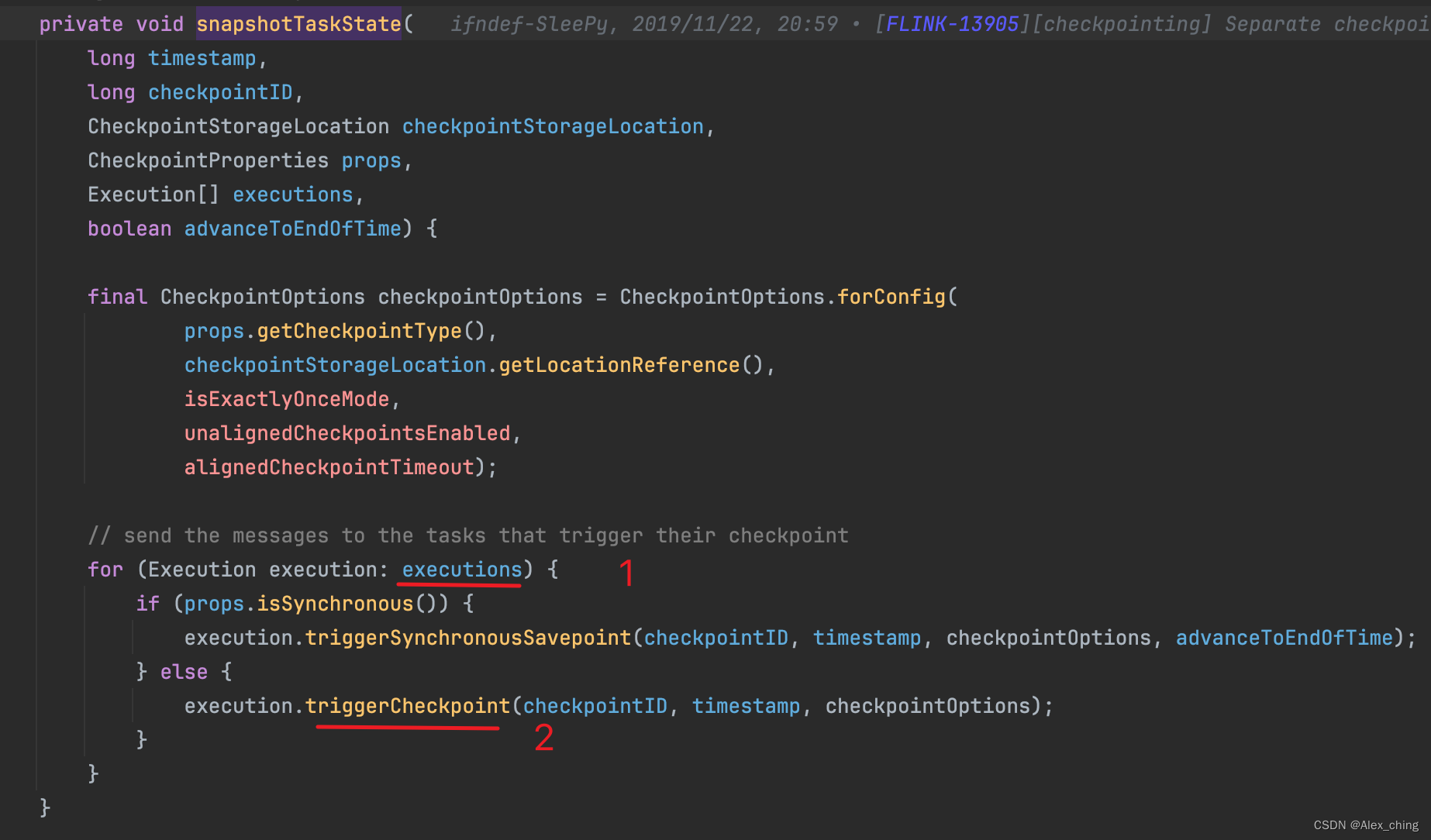
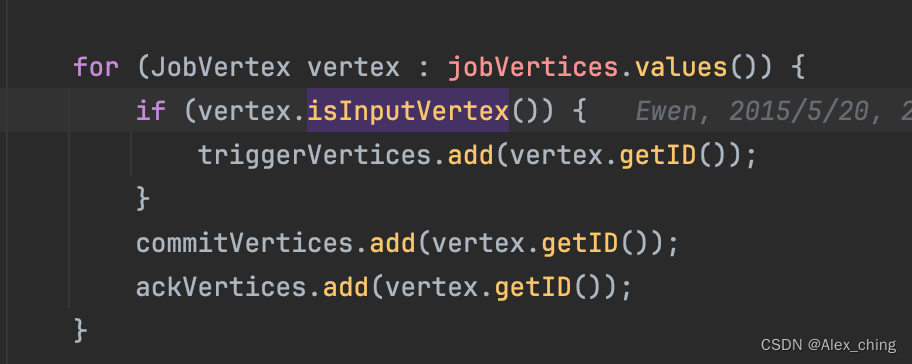
Flink 代码中维护了一个叫tasksToTrigger的数组。

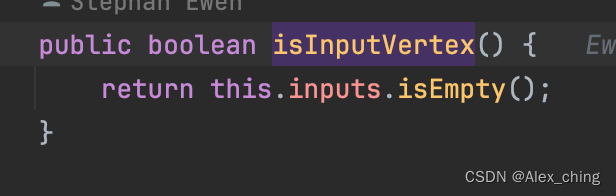
这个地方向前追溯,可以一直到jobgrap的生成。从名字和代码就可以看出,这个里面存的是没有inputchannel的节点,source节点没有inputchannel,所以回答上面的问题,executions 中是source节点,也就是做checkpoint 时 checkpointcoordinate 会给source节点发送rpc。
通过一个很长亮度的调用,最后到了SubtaskCheckpointCoordinatorImpl 中的
public void checkpointState(
			CheckpointMetaData metadata,
			CheckpointOptions options,
			CheckpointMetricsBuilder metrics,
			OperatorChain operatorChain,
			Supplier isCanceled) throws Exception {
		checkNotNull(options);
		checkNotNull(metrics);
		// All of the following steps happen as an atomic step from the perspective of barriers and
		// records/watermarks/timers/callbacks.
		// We generally try to emit the checkpoint barrier as soon as possible to not affect downstream
		// checkpoint alignments
		if (lastCheckpointId >= metadata.getCheckpointId()) {
			LOG.info("Out of order checkpoint barrier (aborted previously?): {} >= {}", lastCheckpointId, metadata.getCheckpointId());
			channelStateWriter.abort(
				metadata.getCheckpointId(),
				new CancellationException("checkpoint aborted via notification"),
				true);
			checkAndClearAbortedStatus(metadata.getCheckpointId());
			return;
		}
		// Step (0): Record the last triggered checkpointId and abort the sync phase of checkpoint if necessary.
		lastCheckpointId = metadata.getCheckpointId();
		if (checkAndClearAbortedStatus(metadata.getCheckpointId())) {
			// broadcast cancel checkpoint marker to avoid downstream back-pressure due to checkpoint barrier align.
			operatorChain.broadcastEvent(new CancelCheckpointMarker(metadata.getCheckpointId()));
			LOG.info("Checkpoint {} has been notified as aborted, would not trigger any checkpoint.", metadata.getCheckpointId());
			return;
		}
        // if checkpoint has been previously unaligned, but was forced to be aligned (pointwise
        // connection), revert it here so that it can jump over output data
        if (options.getAlignment() == CheckpointOptions.AlignmentType.FORCED_ALIGNED) {
            options = options.withUnalignedSupported();
            initInputsCheckpoint(metadata.getCheckpointId(), options);
        }
		// Step (1): Prepare the checkpoint, allow operators to do some pre-barrier work.
		//           The pre-barrier work should be nothing or minimal in the common case.
		operatorChain.prepareSnapshotPreBarrier(metadata.getCheckpointId());
		// Step (2): Send the checkpoint barrier downstream
        LOG.debug(
                "Task {} broadcastEvent at {}, triggerTime {}, passed time {}",
                taskName,
                System.currentTimeMillis(),
                metadata.getTimestamp(),
                System.currentTimeMillis() - metadata.getTimestamp());
        CheckpointBarrier checkpointBarrier =
                new CheckpointBarrier(metadata.getCheckpointId(), metadata.getTimestamp(), options);
        operatorChain.broadcastEvent(checkpointBarrier, options.isUnalignedCheckpoint());
        // Step (3): Register alignment timer to timeout aligned barrier to unaligned barrier
        registerAlignmentTimer(metadata.getCheckpointId(), operatorChain, checkpointBarrier);
        // Step (4): Prepare to spill the in-flight buffers for input and output
        if (options.needsChannelState()) {
			// output data already written while broadcasting event
			channelStateWriter.finishOutput(metadata.getCheckpointId());
		}
        // Step (5): Take the state snapshot. This should be largely asynchronous, to not impact
        // progress of the
		// streaming topology
		Map snapshotFutures = new HashMap(operatorChain.getNumberOfOperators());
		try {
			if (takeSnapshotSync(snapshotFutures, metadata, metrics, options, operatorChain, isCanceled)) {
				finishAndReportAsync(snapshotFutures, metadata, metrics, options);
			} else {
				cleanup(snapshotFutures, metadata, metrics, new Exception("Checkpoint declined"));
			}
		} catch (Exception ex) {
			cleanup(snapshotFutures, metadata, metrics, ex);
			throw ex;
		}
	}
代码中可以看到构造了CheckpointBarrier, source将barrier当成数据广播给下游的所有节点。使用的方法就是operatorChain.brodacastEvent()。这里就回到最开始提到的异步屏障快照算法。
下游收到了barrier,如何进行快照处理的?flink同时有多种类型的checkpoint,他们分别的处理时机是啥,后面我会进一步进行代码分析。
CheckpointBarrier checkpointBarrier =
                new CheckpointBarrier(metadata.getCheckpointId(), metadata.getTimestamp(), options);
        operatorChain.broadcastEvent(checkpointBarrier, options.isUnalignedCheckpoint());


